
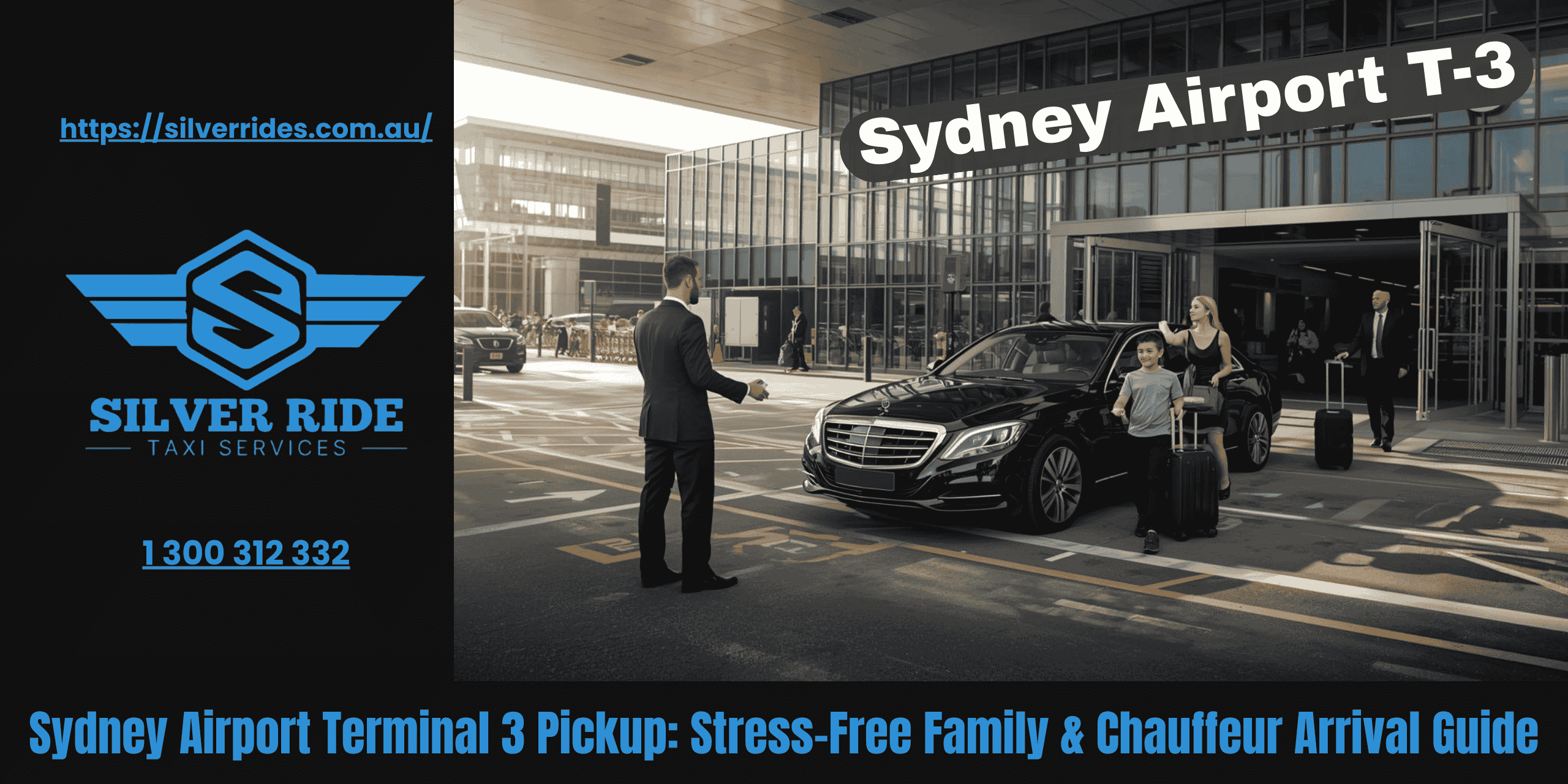
Sydney’s Terminal 3 looks straightforward on a map—but families quickly learn that arriving here is not the same as being collected smoothly. Crowded kerbs, short wait windows, confused pickup points, and tired children can turn what should be a simple arrival into a stressful transition.
A successful Sydney Airport Terminal 3 pickup is less about the drive and more about understanding how the terminal operates in real-world conditions, which is why well-planned airport transfer Sydney services focus on arrival timing and kerbside coordination.
This guide is written for families who want certainty: where to exit, how long to allow, what goes wrong most often, and how to avoid standing with luggage while traffic officers manage vehicle flow. If your priority is calm arrivals, safe seating, and predictable handovers, this article will help you plan properly.
How Terminal 3 Actually Works When You Land
Terminal 3 operates as a high-throughput domestic terminal designed for speed, not lingering. Flights often arrive in close succession, passenger exits funnel into limited kerbside access points, and vehicle stopping time is tightly enforced. Understanding how arrivals, baggage release, and kerbside flow interact is essential to planning a Sydney Airport Terminal 3 pickup that works in real conditions.
Arrival, exits, and passenger flow
Terminal 3 funnels all arriving passengers through a limited number of exit doors. During peak domestic arrival waves, multiple flights offload within minutes. Families often underestimate how congested the space becomes once baggage collection overlaps with existing passengers. This is why a Sydney Airport Terminal 3 pickup should be timed to the moment passengers reach the kerb—not the moment the aircraft lands.
Waiting at the kerb rarely works
Unlike at regional airports, drivers at Terminal 3 cannot wait casually. Vehicles are required to move quickly, and enforcement is strict. Families attempting last-minute coordination often experience missed connections simply because the car was forced to loop again. Clear communication and timing are essential for a smooth family pickup at Sydney Airport.
For reference, Sydney Airport publishes official guidance on Terminal 3 layouts, exits, and passenger flow, which helps explain why pickup timing and positioning matter for families.
Why Family Pickups at Sydney Airport Terminal 3 Are More Challenging
Airport arrivals are optimised for individual movement, not group coordination. Families arrive with competing demands—children, luggage, mobility needs, and emotional fatigue—all converging at once. At Terminal 3, these pressures amplify due to strict kerbside rules and limited waiting tolerance. Without structured pickup planning, small delays quickly become stressful and disruptive for family groups.
1. Managing multiple needs simultaneously
Children need attention, prams need unfolding, elderly relatives need support, and luggage needs supervision. Trying to manage all of this while rushing to meet a car at the kerb is unrealistic. A well-planned arrival pickup at Sydney Airport allows families to move together rather than react under pressure.
2. Emotional fatigue after flights
Even short domestic flights can be exhausting for young travellers. Parents often notice children becoming overwhelmed immediately after exiting the terminal. Reducing waiting time and confusion during an airport transfer in Sydney helps limit emotional overload and keeps the transition calm.
3. Domestic family arrivals are deceptive
Many families assume domestic arrivals are quick and easy. In reality, coordinating a domestic family pickup still requires attention to timing, seating, and space.
4. Communication is critical
Clear messaging between passengers and drivers prevents confusion and ensures a seamless Sydney Airport Terminal 3 pickup.
5. Late-night domestic arrivals
Children are often asleep or overtired. A coordinated arrival pickup at Sydney Airport ensures quick boarding and minimal disruption, allowing families to leave quietly and efficiently in child-friendly airport cars.
6. Multi-generational travel groups
When grandparents travel with families, mobility and patience matter. Planning for elderly passenger care ensures dignity and comfort throughout the arrival process.
Choosing the Right Pickup for Sydney Airport Terminal 3 Pickup
Terminal 3 does not reward last-minute transport decisions. Families benefit most from choosing a method that aligns vehicle arrival with passenger readiness, space requirements, and kerbside restrictions. Selecting the right pickup approach reduces missed connections, repeated vehicle loops, and unnecessary stress at arrival.
- Pre-arranged transport reduces risk: Ad-hoc transport options depend heavily on availability and timing. During busy periods, rideshare queues build quickly, and taxis may be redirected. A scheduled Sydney Airport pickup removes guesswork and supports a smoother family airport transfer at Terminal 3.
- Vehicle type matters: Families often underestimate how quickly space becomes an issue. Between suitcases, backpacks, prams, and personal items, cramped vehicles add unnecessary tension. Choosing spacious SUVs allows families to settle immediately rather than rearrange belongings at the kerb.
Reducing Family Arrival Stress at Sydney Airport Terminal 3
Terminal 3 congestion follows predictable patterns, but stress arises when families arrive unprepared for them. Planning around peak arrival windows, baggage delays, and kerbside enforcement transforms pickups from reactive to controlled. Families who allow realistic buffers and coordinate pickup timing experience faster exits, calmer transitions, and fewer points of friction during Sydney Airport Terminal 3 arrivals.
1. When congestion peaks
Early mornings and late afternoons see the heaviest overlap of arrivals. During these windows, kerb access becomes chaotic. Families scheduling a Sydney Airport Terminal 3 pickup outside peak periods experience faster handovers and calmer exits.
2. Allowing realistic buffer time
Baggage belts can slow unexpectedly, especially for family groups. Building a buffer into the Sydney Airport Terminal pickup prevents rushed exits and missed connections.
3. Door-to-door continuity
Choosing options that provide door-to-door airport pickup reduces unnecessary walking and decision fatigue upon arrival.
4. Creating a secure family environment
From seating to route selection, prioritising family-safe travel ensures peace of mind when attention is divided between children and logistics.
5. Child seating and compliance
Parents should never assume availability at the last minute. Confirming child seat availability in advance avoids unsafe compromises during the family pickup at Sydney Airport and ensures compliance with NSW regulations.
6. Physical comfort after landing
Easy vehicle access, smooth driving, and adequate space contribute to private chauffeur comfort, particularly for children and seniors transitioning from confined aircraft seating.
How Professional Chauffeurs Improve Family Pickups at Sydney Kingsford Smith Airport
Professional chauffeurs improve family arrivals when pickup execution is designed around real airport constraints rather than convenience assumptions. At Sydney Airport Terminal 3, families face strict kerbside enforcement, short vehicle dwell times, and slower exit movement due to children, prams, and multiple bags. This is where a chauffeur for family travel in Sydney becomes valuable.
SilverRides is a Sydney-based chauffeur and airport transfer operator that manages family arrivals by aligning its pickup process with how Terminal 3 actually functions, rather than relying on generic airport assumptions.
Terminal 3 family pickup execution focuses on:
- Timing vehicle arrival to passenger readiness at baggage exit, not flight landing time
- Using permitted Terminal 3 kerbside zones to avoid forced vehicle loops
- Assigning chauffeurs trained in family movement patterns and group coordination
- Assisted luggage handling to allow parents to focus on children and elderly family members at the kerb
Our fleet includes well-maintained sedans, SUVs, and Maxis, suited for baby carriages, luggage, and comfortable family seating for smoother arrivals at Terminal 3. For families who prefer a well-coordinated Sydney Airport Terminal 3 pickup, SilverRides can be contacted on 1300 312 332 to discuss arrival logistics.
Chauffeured vs Other Transport Options at Sydney Airport Terminal 3
At Sydney Airport Terminal 3, transport options differ in how they manage kerbside access, luggage volume, and group movement. Families benefit from comparing how rideshare, taxis, and chauffeured pickups operate at the moment passengers exit the terminal.
Chauffeured pickup vs rideshare
Rideshare pickups at Terminal 3 depend on app coordination, driver availability, and permitted pickup zones, which can misalign with family exit timing. Chauffeured pickups operate on pre-scheduled positioning, allowing vehicles to arrive only when passengers are ready, reducing missed connections at the kerb.
Chauffeured pickup vs taxi queues
Taxi pickups are governed by queue length and dispatcher flow, which fluctuate throughout the day at Terminal 3. Chauffeured pickups bypass queue dependency by aligning vehicle arrival with passenger readiness, giving families a controlled boarding window rather than reacting to queue conditions.
Don’t Just Assume, Plan the Sydney Airport Terminal 3 Pickup
Family arrivals at Sydney Airport Terminal 3 become manageable when decisions are made with the terminal’s realities in mind. Understanding kerbside limits, allowing for family movement time, and aligning pickup logistics to passenger readiness removes much of the uncertainty that causes stress.
If past arrivals felt chaotic, the solution is rarely more speed—it is better structure. Planning with clarity turns Terminal 3 from a pressure point into a predictable final step of the journey, allowing families to leave the airport feeling settled, organised, and ready to get home.